In poll worker recruitment, more is not (necessarily!) more
We have holistically explored poll worker recruitment through original research, direct service, and interdisciplinary literature reviews. Focusing on applicant quality can drive improvement.


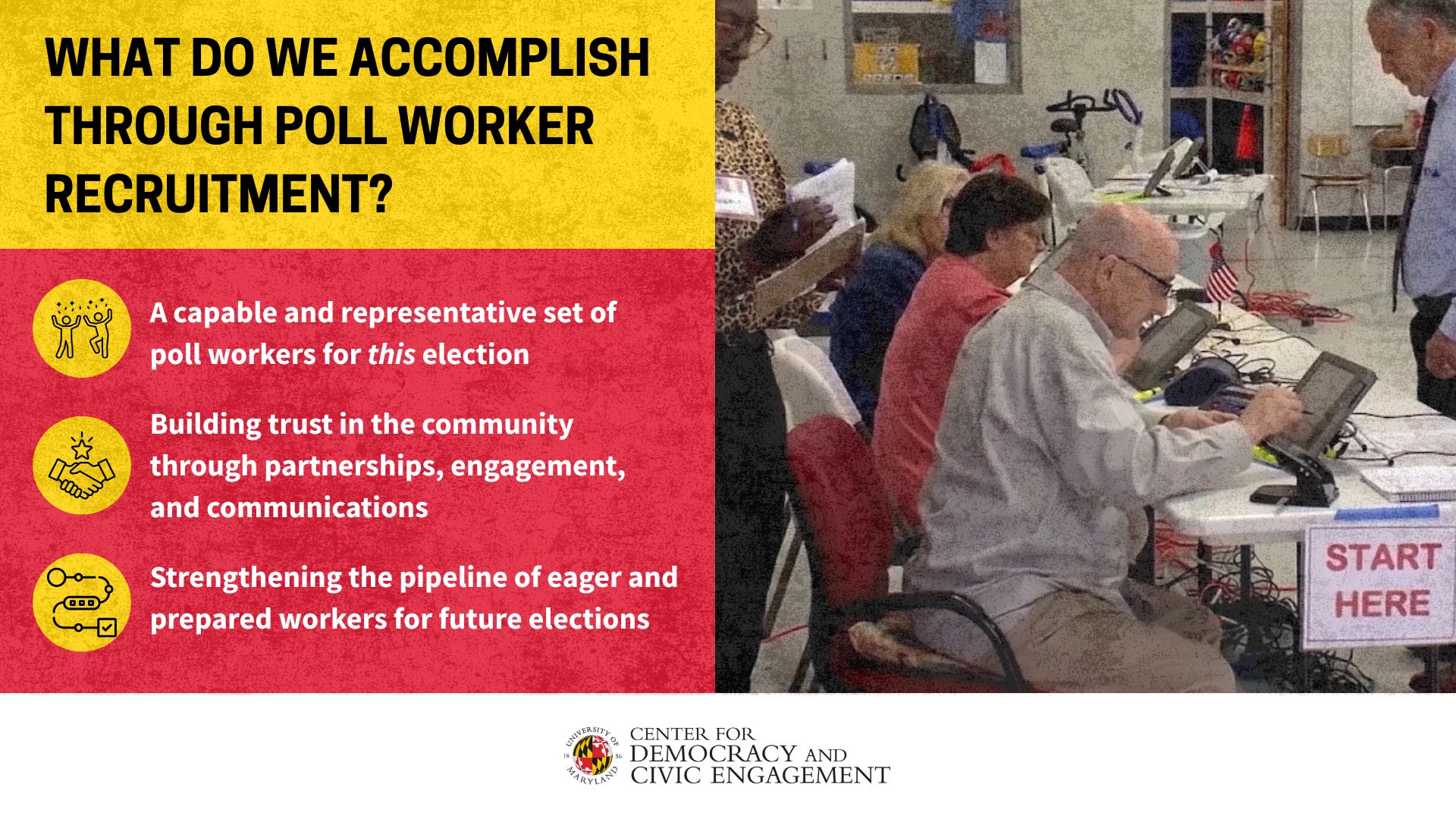
Election officials don’t just need more bodies. They need a pipeline that delivers reliable volunteers who sign up in time to attend training - especially in “off year” elections.
In the 2024 election, our team at CDCE thought about poll workers A LOT. We worked with local election officials in our region to support and improve recruitment processes. We sent former election officials to election offices across the country to document the use of poll workers as one of the “surge staffing” strategies employed to get through the busiest part of the election calendar. We scanned academic literature from business and public policy and beyond to incorporate insights about best practices. We analyzed survey responses from poll workers about their motivations for serving. We compared lists of applicants to lists of hired poll workers to see whether people who expressed an interest in serving ended up following through with training and working on election day.

Inclusive marketing is important. So is making sure recruiting campaigns are well timed and clear.
Election officials don’t have an unlimited capacity to handle last-minute recruitment campaigns. It takes time to handle the intake of applications, communicate with potential poll workers about specific vacancies, and get them onboarded, trained and ready for Election Day. Poll worker training can start months before an election and may end as early as six weeks before Election Day, when those who were responsible for training may be shifting their attention to serving voters. The reality is that applicants who respond to last-minute calls to action may never get a call back. Even if recruitment is still open, election officials may have few seats in training classes left that are only for filling certain positions. Once-eager poll workers may become disillusioned and lose confidence in the process when they get turned down or ghosted by temporary workers facing a flood of applicants they can’t manage.
But wait, you say - don’t election officials need our help? The answer is yes! To make sure that help is effective, we recommend the following:
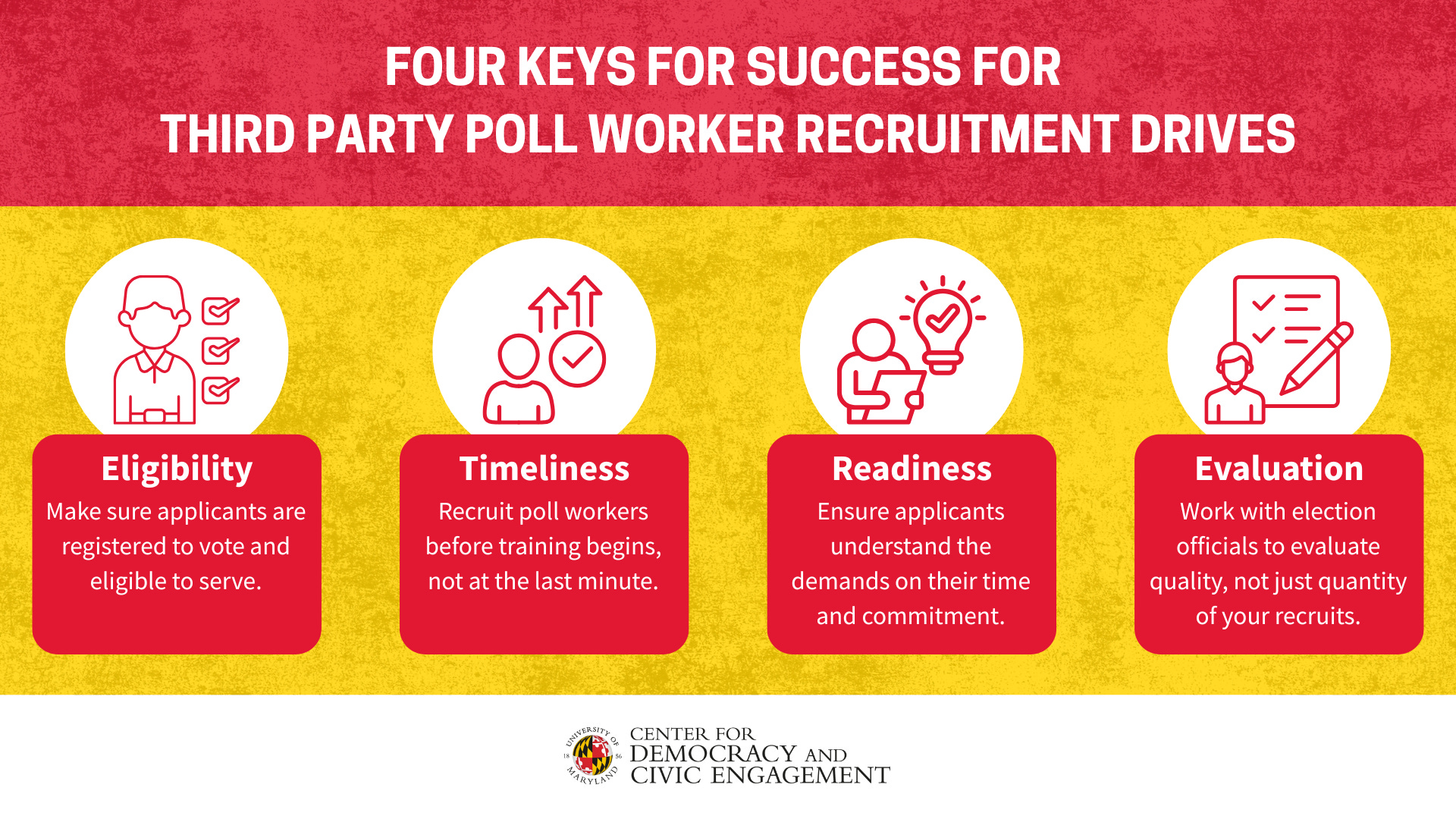
Make sure your efforts are timely: Schedule recruitment campaigns to have maximum impact as early as possible in the window of time that election officials have to train their workers. Educate potential poll workers on the value of signing up early, not waiting until the last minute. And recruit for those off-year and special elections, when election officials need the help most.
Ensure eligibility: In many states, poll workers need to be registered to vote in that state by a particular date, be of a certain age, have certain skills or physical abilities, or meet other eligibility requirements in order to serve.
Focus on readiness: Make sure applicants understand that serving as a poll worker is not a one-day commitment. It requires an investment of time in training and followup communication. It can be demanding. Local election officials are trusting poll workers to perform duties mandated by law that affect whether votes count or not, and that may involve explaining what they are doing to large numbers of voters. They are trusting poll workers with custody of sensitive elections infrastructure such as e-pollbooks, optical scanners, and other election equipment.
Provide off-ramps for those applicants who do not end up serving as poll workers: An effective poll worker recruitment effort will yield many more applicants than will end up serving at the polls. Yet few recruitment programs consider how to engage those applicants who do not end up serving as champions for the election process in their community. This is a huge opportunity for our field to do better!
Election offices, too, can often improve their poll worker recruitment. We recommend the following:
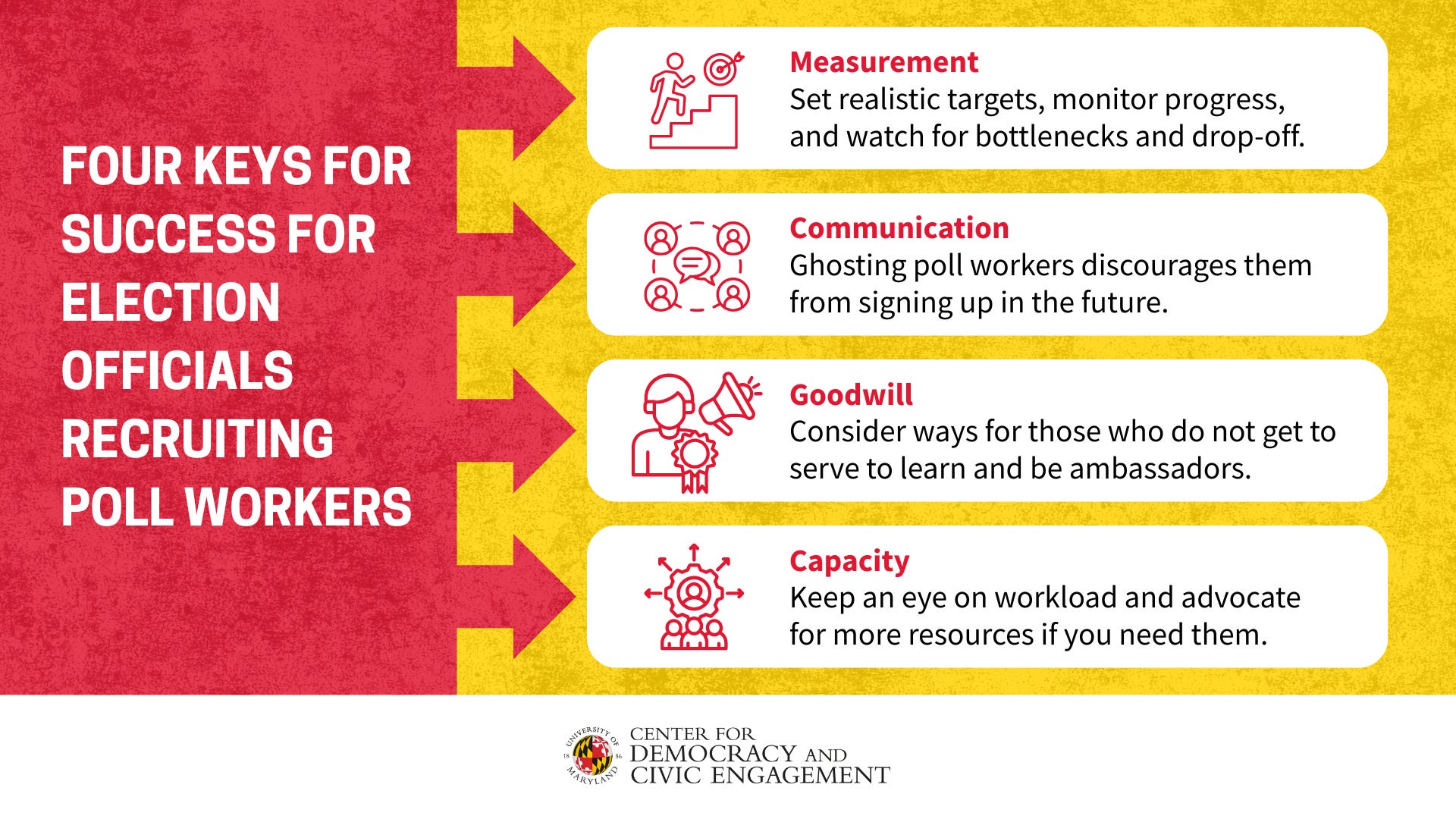
Prioritize management visibility: Poll worker recruitment is often a task assigned to temporary workers, and during the weeks leading up to an election, their workload can spiral out of control fast. Managers in election offices need to have visibility into the workload of their staff to identify bottlenecks and process failures in time to fix them, and to help them prioritize any last-minute recruitment needs.
Set realistic targets: Over recruit. Set a goal of three to four times more applicants than you have positions to fill. Plan for excess capacity in training classes. Identify positions that you expect to be hard to fill, and target your outreach to find applicants for those roles.
When your pipeline is full, stop recruiting: Time and again, we hear voters say “I signed up to be a poll worker, but they never called me back.” Make sure that you have the capacity to train, assign and communicate with those who have already applied. Ghosting potential poll workers discourages them from signing up again in the future.
Over communicate: Do you have candidates stalled in the recruiting pipeline who are not on track to be hired? Why? If you are waiting to confirm future training dates, let them know. If you are forwarding their application to someone else, let them know. Regular communication builds trust and goodwill. Poor communication damages the brand of the election office and undermines efforts to build trust.
Provide a positive experience for those who do not get to serve: How can you engage applicants who do not end up serving at the polls as ambassadors for your office? These individuals could help build trust in elections in the community or support election outreach and communications even if they can not serve as poll workers. Engaging them with clear communications, online voter education and training, and inviting them to be champions for the local election office in their community is a huge opportunity for our field to do better!
If you don’t have the resources to do these things, speak up: Voters benefit when election officials and the public officials who make decisions about their budgets work together to align expectations with reality. Decisions have consequences, and election offices that are subject to hiring freezes and budget cuts may not be able to recruit as many workers or to respond to applicants as quickly. Public officials have an opportunity to show their support for election administrators by making sure they have the resources they need.
The upshot? Almost everyone doing poll worker recruitment should be focusing on the quality of outcomes, rather than the quantity of applications!
The midterm elections provide election officials and partners with an opportunity to reset expectations around poll worker recruiting and what success looks like. The last decade has been a time of dramatic change for elections. Expectations and the complexity of the process are rising. More and more Americans are voting early and voting by mail, which takes the focus of election office staff away from Election Day operations.

In many states, though, the number of precincts and need for poll workers has not decreased. Poll worker recruitment and management work competes for bandwidth with pre-election canvassing of mail-in ballots and expanded in-person early voting operations. The pandemic disrupted the election workforce, resulting in generational turnover in many offices. Record numbers of election officials have quit their jobs, citing long hours and a lack of support. The link between exhaustion in understaffed offices and errors that can harm voter confidence has become clearer.
In this environment, it has never been more important for election officials’ partners to identify where our efforts are best positioned to help, and where poorly timed or poorly managed efforts may be doing harm by burning election officials out or ghosting volunteers. We can improve trust with systemic changes and continuous improvement to ensure every polling place is properly staffed by a capable, effective, and representative group of poll workers. Increasing focus on the quality of the process, rather than the number of applicants, should be an urgent priority for both election agencies and partners.
Sam Novey is the Chief Strategist at the University of Maryland Center for Democracy and Civic Engagement. Lynn Handy is a Senior Fellow at the University of Maryland Center for Democracy and Civic Engagement
This is such great advice. There are great lessons here that apply well to any effort to recruit volunteers for meaningful work.
Really strong emphasis on the timing issue that gets overlooked. The point about ghosting applicants who sign up late is something I've seen happen irl and it absolutely kills future participation. Setting that 3-4x over-recruitment target makes alot of sense when you factor in dropout rates, but most orgs dont plan for that buffer. The off-ramp concept for non-selected applicants is brilliant, those people already showed civic intrest and could be channeled into other roles.