What we're learning about local resident voting rights
Through research partnerships with community groups we are learning about local resident voting policies. With enough investment, they can be a powerful tool for creating inclusive local government.

Our nation has entered an era characterized by harsh treatment, exclusion, and targeting of immigrants, especially by federal agencies. Yet some localities have adopted an inclusive approach to immigrant residents that extends voting rights to all residents, regardless of citizenship status. These local voting rights rest on arguments that as vital contributors to their local communities, immigrants deserve a say in local elections. Though non-citizens are barred from voting in federal or statewide elections in this country, some cities and towns in California, Maryland and Vermont, as well as the District of Columbia, allow non-citizen residents, including those with permanent resident status (“green card” holders), visas, and in some cases who lack legal authorization to live in the U.S. to vote in some or all local elections.
In 2024, I joined a research team to study how local voting rights impact communities. Our study focused on four key locations, chosen to compare places that allow non-citizen voting with those that do not:
Northern California: We compared two large, demographically similar cities— one which allows non-citizens to vote in school board elections one which does not.
Maryland: We looked at two smaller communities— one which allows non-citizen voting in local elections one which does not.
To understand the real-world impact of these policies, we interviewed 21 experts (including election officials and immigrant rights advocates) and 49 non-citizen residents. We also held two focus groups with non-citizen residents to hear their experiences firsthand.
What have we found so far? Our findings fall into four categories.
1) Implementation requires investment
Granting the right to vote is only the first step in expanding the vote to communities experiencing disenfranchisement. Similar to other modern suffrage efforts, like those allowing 16-and 17-year-olds to vote and felon re-enfranchisement policies, once local resident voting rights are passed, the real work of implementation begins.
In this case, movements face challenges in terms of raising awareness in immigrant communities about the right to vote. Staff capacity related to understanding new policies and educating communities about their rights is a major challenge to full implementation of new voting rights. These challenges are common across modern suffrage movements: educating officials on policy changes and ensuring newly enfranchised citizens understand their rights and how to exercise their vote. But, there are also unique challenges for local resident voting programs. The first is the often limited capacity of local election officials to conduct outreach in multiple languages to better connect with immigrant communities. The second is to address the very real fears that non-citizen residents have about registration and potential misuse of registration records for immigration enforcement. In a practitioner brief produced as part of this study, we discuss best practices with regard to safeguarding data and privacy.
2) The policies increase political efficacy even if people are too afraid to fully participate.
Community concern that participation will make them vulnerable to targeting by ICE via registration lists is real. This was the dominant theme in our Maryland interviews with election officials, CBO staff, and local residents. But, this fear did not dampen the enthusiasm for participation. One participant in a small Maryland community stood out for her willingness to vote in local elections despite the acknowledged risks:
I want to emphasize the terror and the fear that we have of being separated from our children. And then who is going to take care of our children if they take us away?
It’s been a small amount of time since I heard that you could vote [in local elections] as a non-citizen. If I could do it, I’ll do it. I understand they might take me and deport me.
The results of our project indicate that the right to vote in local elections changes how non-citizen feel about their community. When immigrants have the right to vote, they are much more likely to feel that local leaders actually care about them. It gives them a sense of political efficacy, fostering a belief that their voice matters and they have the power to create change. Interestingly, this shift in mindset doesn't actually depend on whether they show up to the polls. Simply knowing they have the right to vote is enough to transform their relationship with the local government and make them feel like a recognized part of their local community.
3) Suffrage movements take time. Modern ones can learn from each other - and from the past.
Movements to expand voting rights face institutional challenges and are not always popular with the public. Nevertheless, even in a hostile climate, there are success stories. The felon re-enfranchisement movement, which was catalyzed in the 1960s, slowly gained traction over the next half-century. Since the late 1990s, more than 25 states have expanded voting eligibility to millions of people with felony convictions. Christopher Uggen and his colleagues, including UMD scholar Robert Stewart, report that although The Sentencing Project estimates that four million Americans were prevented from voting due to felony disenfranchisement laws in 2024, this number represents "a figure that has declined by 31% since 2016, as more states enacted policies to curtail this practice and state prison, probation and parole populations declined.”
More localities than ever allow 16-and 17-year-olds to vote. In 2013, Takoma Park, MD, lowered the voting age to 16 for municipal elections. By 2026, ten jurisdictions in Maryland as well as Albany, CA, and Brattleboro, VT, allowed 16- and 17-year-olds to vote in municipal elections, and three (Berkeley and Oakland, CA, and Newark, NJ) had lowered the voting age to 16 for school board elections. And with regard to non-citizen voting, the number of jurisdictions allowing local residents to vote in municipal elections or school board elections is growing, even as some states and national leaders attempt to change the ways that voters prove citizenship in federal elections. An important feature of all of these movements is playing the long game and building power under a variety of political climates.
4) Community research partnerships help us learn from these policies in much deeper ways.
One of the most gratifying aspects of this work is collaboration with local non-profits. It would have been impossible to hear from immigrants themselves without our community partners, including We Are CASA in Maryland and the Immigrant Parent Voting Collaborative in California.
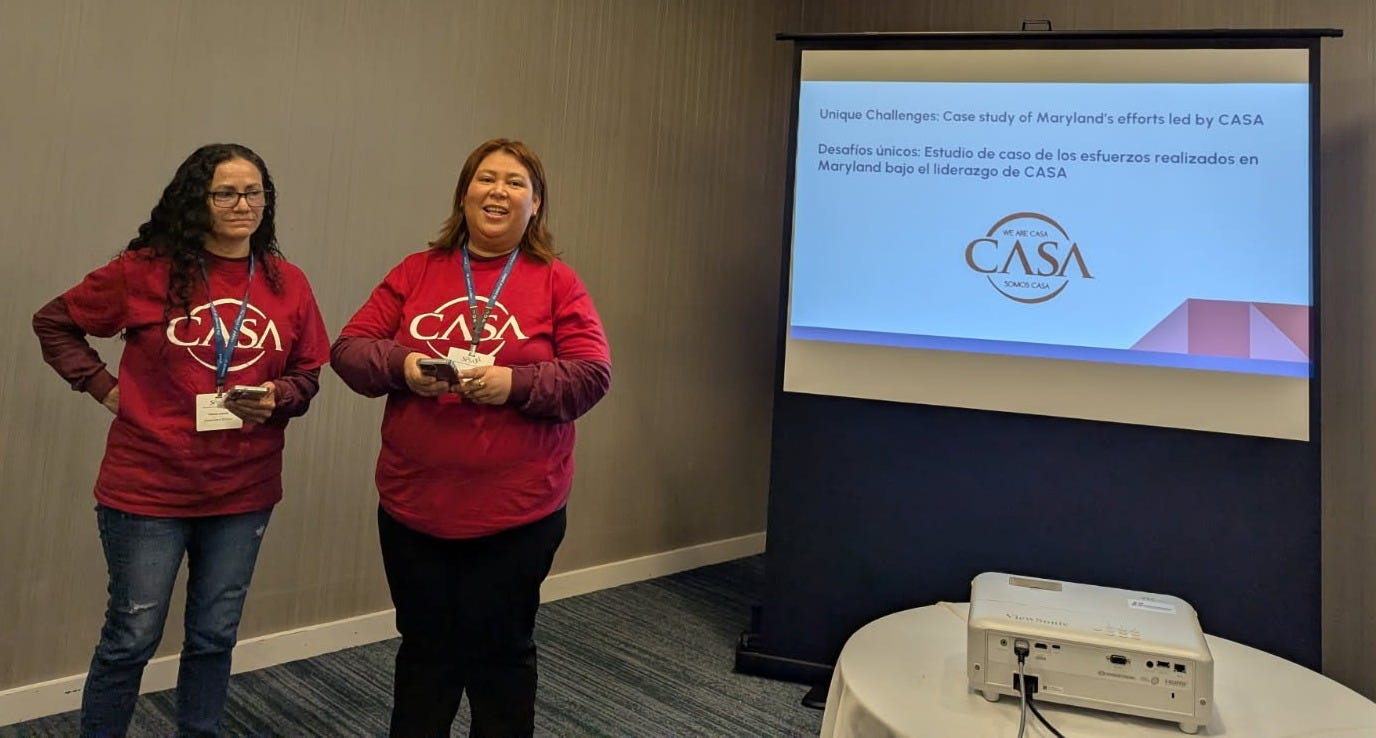
We had the opportunity to co-present parts of this research with two staff members from We Are CASA at the Southern Political Science Association annual meeting in New Orleans, LA in January of 2026. We worked together with CASA staff to develop the research presentation, translating our research and the presentation into Spanish. The presentation was conducted in Spanish and English, with CASA staff presenting key aspects of the research. By presenting alongside CASA, we didn't just share data, we gave the audience a front-row seat to the real-world challenges and successes of local voting campaigns from the perspective of organizations doing this important work.
The upshot? Even in this political moment local resident voting remains a viable and powerful policy option for some municipalities.
The current climate surrounding immigration in the United States obviously presents significant challenges to localities seek to use resident voting policies to advance goals around making local government more inclusive. Our research shows, however, that these policies remain viable and impactful. Localities that adopt and invest in implementation and public education can see benefits in the engagement and political efficacy of residents. And while movements to expand voter eligibility may feel challenged by the current moment, there are examples of both historic and current suffrage movements for other groups of residents of the United States that have overcome these types of challenges before. We look forwarding to continuing to work with our community research partners to learn from these policies.
Janelle Wong is a Faculty Fellow at the University of Maryland Center for Democracy and Civic Engagement. She serves as Director of Asian American Studies and Professor of American Studies and Government and Politics at the University of Maryland. In April 2026 she was elected to the American Academy of Arts and Sciences.
 |
|