Sending postcards to all eligible but unregistered citizens increases participation without advantaging either major political party
A new study I co-authored with CDCE Fellows Alauna Safarpour & Jared McDonald, along with Lisa Bryant shows that the ERIC program increased participation without advantaging either party.

States can improve the accuracy of voting rolls and expand outreach to eligible but unregistered citizens through secure data sharing.
The Electronic Registration Information Center (ERIC) is a multi-state collaboration that facilitates essential election administration functions. Member states share administrative data. For example, someone who was registered in Maryland but moves to Kentucky will be identified as having moved. This allows Maryland to remove them from their records and Kentucky to contact them about registering to vote there. This helps ensure clean voter registration lists and to encourage individuals who are eligible but unregistered (EBUs) to register to vote.
Despite ERIC’s primary focus on maintaining the accuracy of voter rolls, in 2022 some activists accused it of being a tool for partisan electioneering, prompting nine Republican-led states to leave ERIC. To assess the validity of a central criticism made against ERIC, our team leveraged field experiments conducted by two member states, Pennsylvania and Nevada (two important swing states), during the 2016 election. Following on our earlier publication on the overall effect of postcards from state election officials on voter registration and turnout, we tested whether there was evidence to suggest a partisan advantage. This new research is forthcoming in PS: Political Science & Politics.
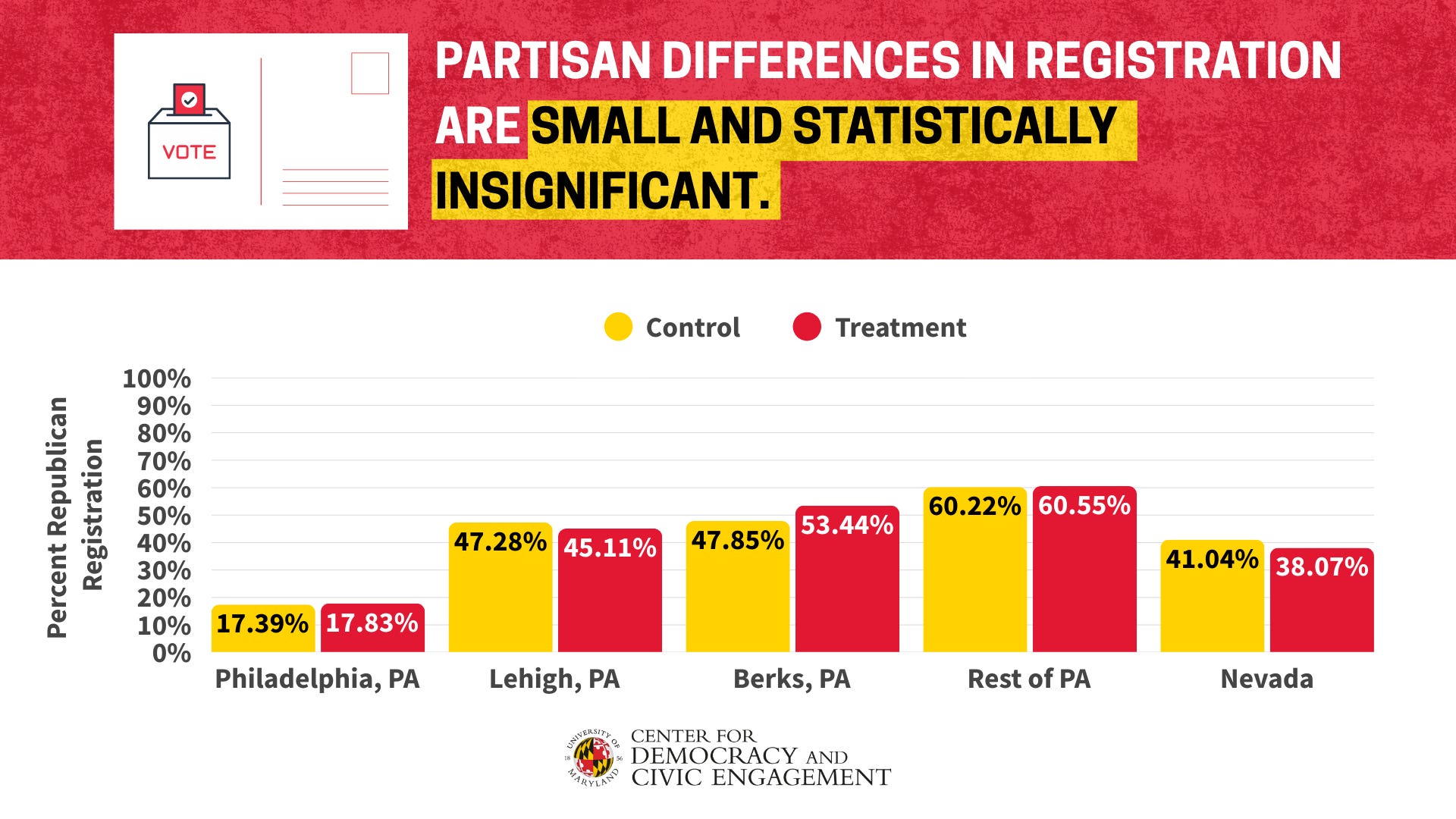
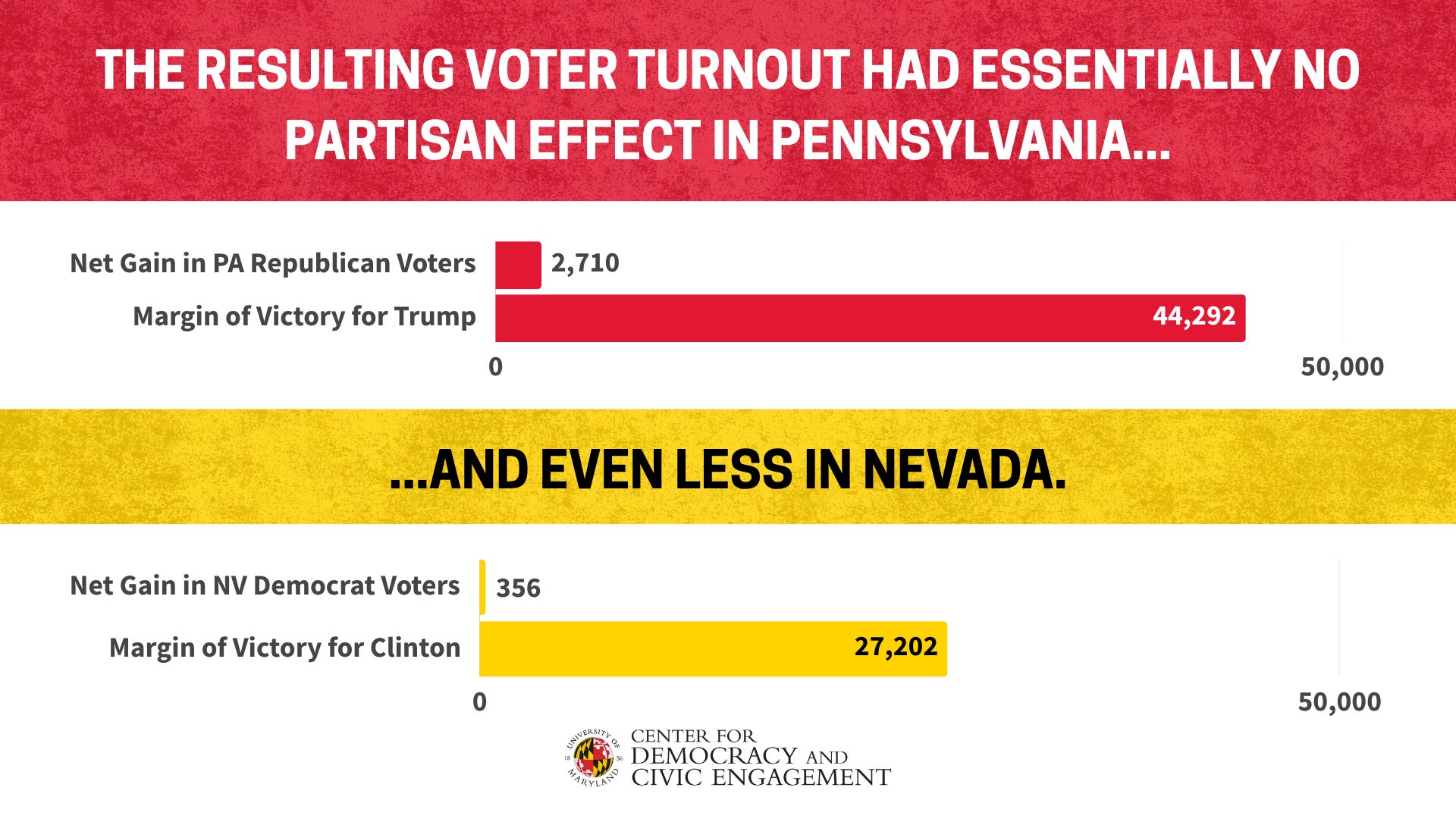
ERIC mailings boost registration and turnout, but the effects are relatively modest. Those who respond reflect the political leanings of their communities. One party is not advantaged by this process.
The perception that facilitating greater voter registration has electoral consequences is not new. Neither is support for or opposition to policies based on perceived political advantage. For instance, Biggers (2019) shows that individuals are more likely to support electoral reforms when they are informed that the reforms will benefit their party. Similarly, Caron (2022) finds that state legislators’ support (or opposition) to same-day registration is associated with perceptions of an electoral advantage. Yet the research on whether state election policies actually produce a partisan advantage is mixed, and often challenging to conduct due to data limitations.
The data and methods we bring to this debate offer numerous advantages over previous studies. We had the benefit of working with state election officials, large samples, information on partisan registration, and the ability to conduct a randomized controlled trial (RCT) -the gold standard for making causal claims. The 2016 Pennsylvania RCT began with a list of 2,397,384 likely EBUs from the Pennsylvania Department of Transportation that was matched to the voter file. As an ERIC member, the state was required to contact 95% of likely EBUs, so a random subset of 5% were assigned to a control condition and were not contacted. The 95% received a postcard from the Pennsylvania Department of State informing them of their ability to register to vote. The postcards informed recipients that they may not currently be registered to vote, emphasized the approaching deadline, noted that registration was “quick and easy,” provided a website to register online, and listed the eligibility criteria. The RCT varied content on the back of the postcard, though all were politically neutral.
The Nevada study followed a similar design to the Pennsylvania study and occurred contemporaneously. The study began with 206,722 likely EBUs from the Nevada Department of Motor Vehicles, matched to the voter file. The research team grouped individuals by household, then randomly assigned them to either the control or one of two treatment groups. Treated individuals received one of two versions of the postcard from the Nevada Secretary of State. Both versions included information about registration, and one provided a QR code to facilitate registration.
The upshot? Our results reaffirm the value of state-led efforts to reach unengaged citizens.
Assessing the validity of criticism that these efforts have partisan effects is important. Our evidence indicates these criticisms lack basis. States can reach out to unengaged citizens who might be willing to participate in the civic process if invited, without worrying that they are advantaging one party over another. Government officials serve a unique role in efforts to engage new voters, since they have the means to target those who lack a voting history and the government may be more trusted than partisan organizations. ERIC has a crucial role to play in registration efforts, assisting states both in maintaining the integrity of the voter rolls and aiding in the identification of people who are eligible but have not registered to vote.
Mike Hanmer is the Director of the University of Maryland Center for Democracy and Civic Engagement, Professor and Michael Miller Endowed Faculty Fellow in Government and Politics, and co-Principal Investigator of the Maryland Democracy Initiative.1
Support for the original project was provided by The Pew Charitable Trusts (Grant No. 29785). The views expressed herein are those of the author and do not necessarily reflect the views of The Pew Charitable Trusts, the states in the study, or ERIC, nor was this analysis requested by any of those entities. Data for the original project were provided by Pennsylvania and Nevada. No additional funding nor data were provided for the new research discussed here.
Thank you. There weren't opportunities for spillover effects with our design. We randomized at the household level and then everyone in a household that was selected for treatment got an individually addressed postcard (the postcard in any given household with multiple people was identical in all other ways than the name).