Who couldn't verify their citizenship and identity if the SAVE America Act passed?
The Senate is debating a package of voting proposals. Three surveys we conducted with VoteRiders shed light on which U.S. citizens over 18-years-old might face barriers to voting if it passed.


In the coming days, the U.S. Senate will debate the SAVE America Act. Among other things, the bill would require voters to:
present documentary proof of citizenship - U.S. passport, U.S. Birth Certificate, U.S. Certificate of Naturalization, or U.S. Certificate of Citizenship - when registering to vote or updating voter registration; and
present government issued photo ID when voting in-person or by mail.
We have worked with VoteRiders since 2023 to conduct surveys at the national and state levels that estimate how many U.S. citizens over the age of 18 lack easy access to these documents, and which groups are disproportionately affected by policies like the ones proposed in the SAVE America Act.
DPOC Findings: Below are the key takeaways about who lacks easy access to the documentary proof of citizenship needed to register to vote if this proposal passed. We estimate that more than 21 million U.S. citizens over the age of 18 do not have or lack easy access to these documents. You can see the results from the full survey here.
ID Findings: The SAVE America Act also includes provisions requiring voters to show government issued photo ID to vote either in-person or by mail. We estimate that 2.6 million U.S citizens over the age of 18 lack government issued photo ID of any kind. An estimated 34.5 million people do not have a driver’s license or official state ID card, or do not have one with their current name and address on it. A synthesis of results about access to ID is here.
All of our surveys - including state specific surveys showing how the partisan impact of these laws might be negative for Republicans in key states like Texas - are available here (and visualizations of key findings are available here) .
How we study this issue: An overview of the strategies we use to estimate who lacks the proof of identity and citizenship they need to vote is available here.
As is always the case with surveys like these, there is too much data to include everything in the reports. If you have additional questions about who lacks the proof of residency, identity, and citizenship they need to vote that might be answered with these data, please reach out to us so we can run additional analyses to meet your needs. Interested parties can reach out to CDCE’s Chief Strategist Sam Novey at 410-903-6911 or snovey@umd.edu.
Which U.S. citizens lack easy access to documentary proof of citizenship?
Many people want to know more about which U.S. citizens lack easy access to documentary proof of citizenship. Here’s what our research says.
We found over 21.3 million U.S. citizens lack easy access to documentary proof of citizenship.
As proposals to require documentary proof of citizenship (DPOC) to register to vote have proliferated in the U.S. Congress and state legislatures, policy makers and the public are asking who would be impacted by these policies.
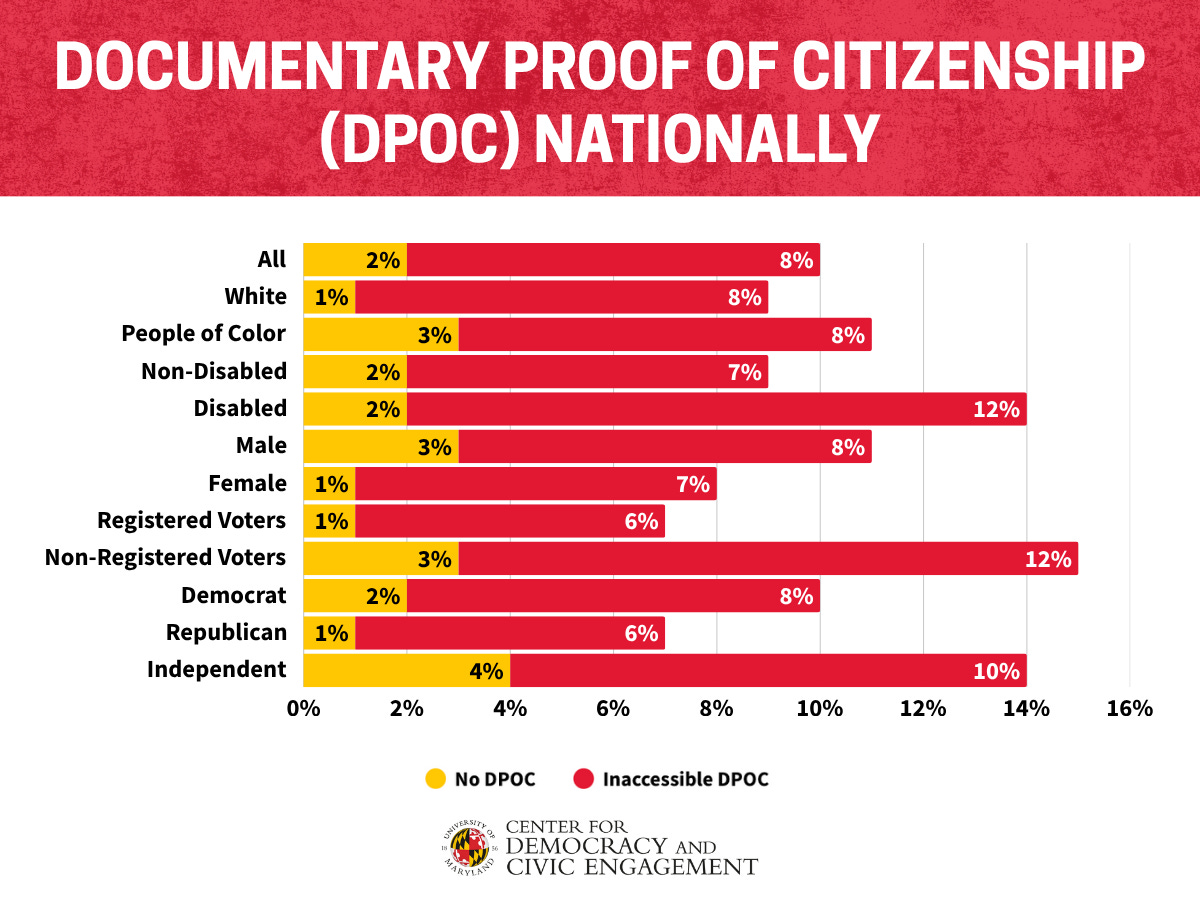
Three unique surveys CDCE conducted in partnership with VoteRiders and the Brennan Center for Justice in 2023 and 2024 provide some of the best estimates of who lacks documentary proof of citizenship. One survey had a nationally representative sample of the adult U.S. citizen population1, the second had a representative sample of adult U.S. citizens in Georgia2, and the third had a representative sample of adult U.S. citizens in Texas3. Each survey asked whether respondents had the types of identification and documents needed to prove citizenship, with the state surveys tailored to the specific voter ID laws in those states4.
With regard to documentary proof of citizenship, the surveys asked whether adult U.S. citizens owned certain documents (U.S. Birth Certificate, U.S. Passport/U.S. Passport Card, U.S. Naturalization Certificate, and U.S. Certificate of Citizenship), and if so, whether the respondent could access the document(s) the next day if they had to do so, which we treat as a measure of ready access. All of the results reported here are weighted and population count estimates are based on data from the U.S. Census.
Men - especially young men - are particularly likely to lack easy access to documentary proof of citizenship.
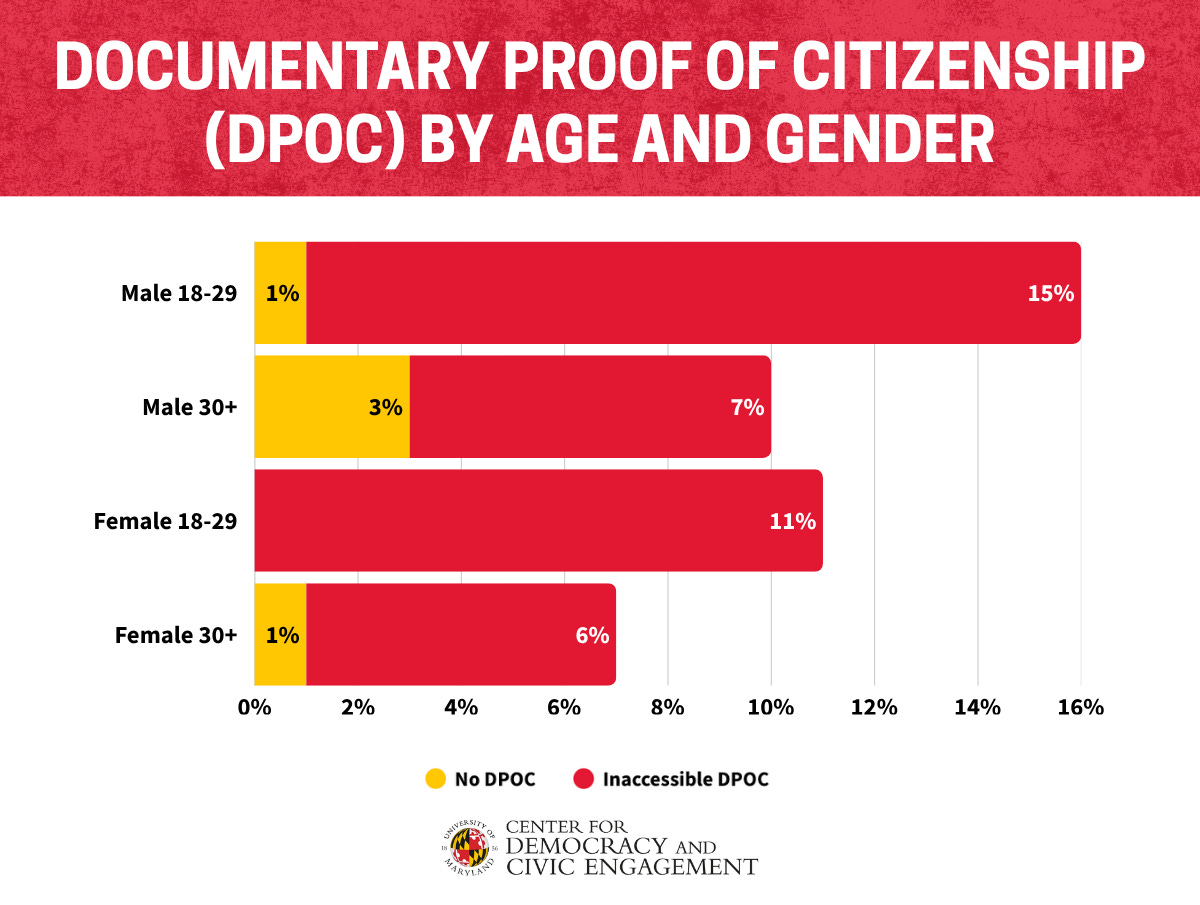
More males (over 12 million, 11%) than females (over 9 million, 8%) do not have or cannot easily access DPOC. Importantly, the estimate for females should be viewed as a lower bound, as we do not have an estimate for the number of males or females whose current legal name does not match the name on their DPOC, and women are more likely to change their names upon marriage or divorce. We did not ask about access to marriage certificates or divorce certificates, which married people typically use to show proof of a name change.
In some states more Democrats than Republicans lack easy access to documentary proof of citizenship. In other states, it’s the other way around.
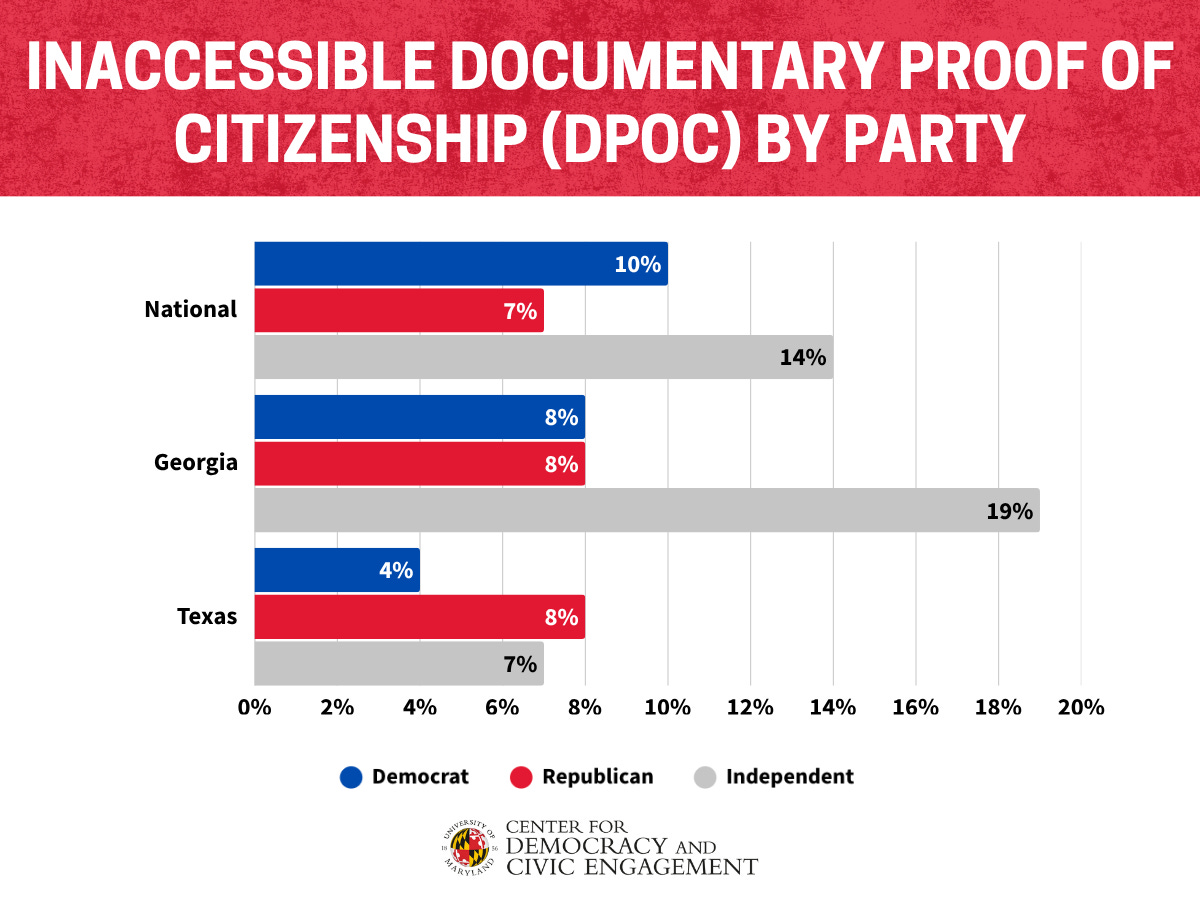
While nationally we found that more Democrats than Republicans lack easy access to documentary proof of citizenship, we found different patterns at the state level. In Georgia, Democrats and Republicans lacked easy access to DPOC at the same rate. In Texas, Republicans were twice as likely as Democrats to lack easy access to DPOC.
Young people are more likely to have documentary proof of citizenship but less likely to have easy access to it.
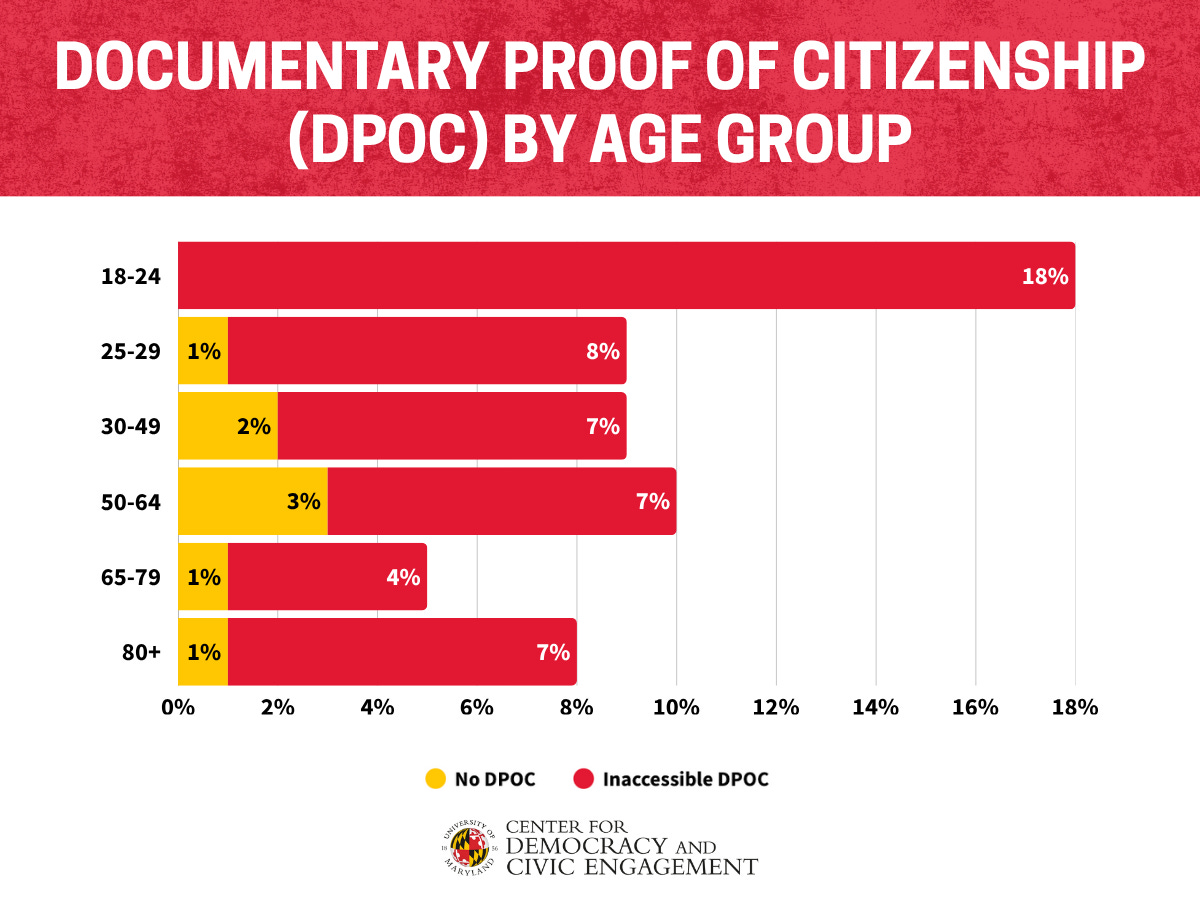
We found that 18 - 24 year-olds struggle most with the issue of easy access to their citizenship documents. Imagine someone in their late teens or early 20s who recently moved away from their hometown. They might not take their birth certificate with them to their new residence. They may not have taken responsibility for storing personal documents that remain with parents or other family. These U.S. citizens may not know where their documentary proof of citizenship is stored. Or they may not be physically close to the place they are stored. Under policies requiring citizens to show documentary proof of citizenship when registering to vote, these U.S. citizens would face substantial challenges.
The upshot? Many U.S. citizens of all political identities lack easy access to documentary proof of citizenship.
Sam Novey is Chief Strategist at the University of Maryland Center for Democracy and Civic Engagement. Jillian Andres Rothschild is a PhD student studying American public opinion and political psychology in the University of Maryland Department of Government and Politics. Mike Hanmer is Director of the Center for Democracy and Civic Engagement and the Michael Miller Endowed Faculty Fellow in Government and Politics.
The national survey was conducted using a sample of 2,386 adult US citizens drawn from SSRS’s probability panel and a random sample of known pre-paid cellular phone numbers. Included in the sample are oversamples of 18-24-year-olds, Black respondents, Hispanic respondents, Black and Hispanic 18-24-year olds, and individuals with income less than $30,000 per year. The survey was fielded 9/12/23 -10/4/23. For more details see https://cdce.umd.edu/sites/cdce.umd.edu/files/pubs/Voter%20ID%20survey%20Key%20Results%20June%202024.pdf
The Georgia survey was conducted using a sample of 1,258 adult US citizens who reside in Georgia from SSRS’s probability panel with a supplement from the Verasight probability panel. Included in the sample are oversamples of 18-24-year-olds, Hispanic respondents, and individuals with income of less than $30,000 per year. The survey was fielded July 18, 2024 through August 11, 2024. For more details see: https://cdce.umd.edu/sites/cdce.umd.edu/files/Voter%20ID%20Report_Georgia.pdf
The Texas survey was conducted using a sample of 1,210 adult US citizens who reside in Texas from SSRS’s probability panel with a supplement from the Verasight probability panel. Included in the sample are oversamples of 18-24-year-olds, Black respondents, and individuals with income of less than $30,000 per year. The survey was fielded July 18, 2024 through August 11, 2024 For more details see: https://cdce.umd.edu/sites/cdce.umd.edu/files/Voter%20ID%20Report%20Texas.pdf
The toplines for the Georgia and Texas surveys can be found at: https://cdce.umd.edu/sites/cdce.umd.edu/files/State%20Surveys%20F24%20Toplines%20Final.pdf