Why policy reforms can't replace voter registration drives
Thousands are hosting voter registration drives today to celebrate National Voter Registration Day. These actions matter even as "automatic" voter registration and other policy reforms expand.

Why do voter registration drives still matter in a world where many states have “automatic” voter registration?
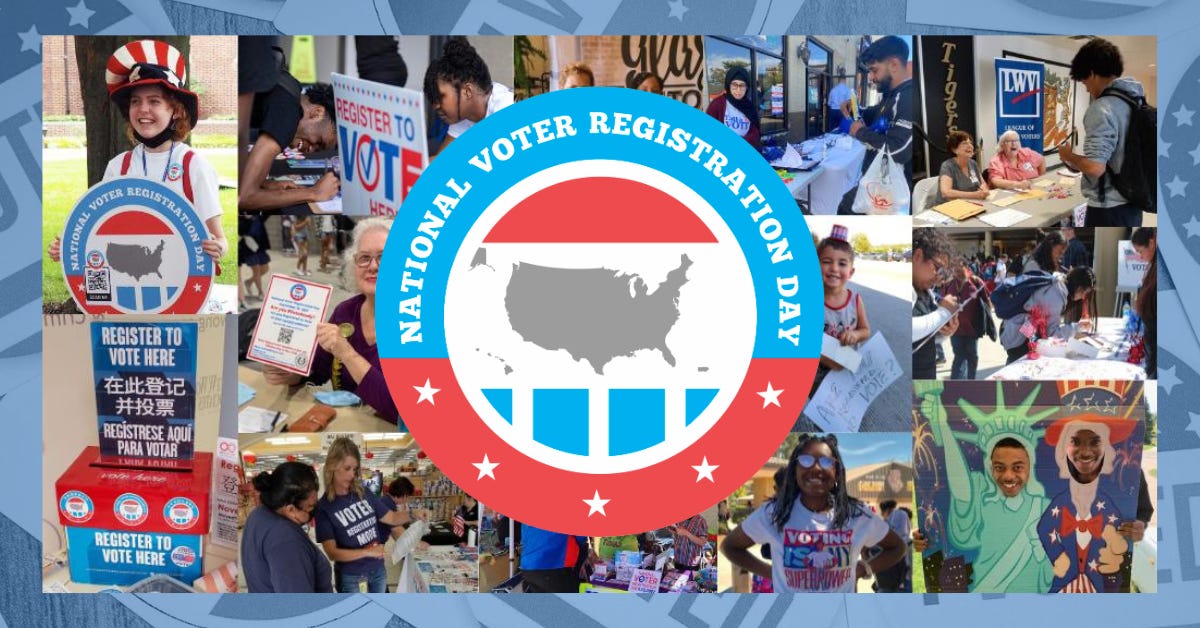
Today is National Voter Registration Day, a day of celebration for that most wholesome ritual of elections - the local voter registration drive. In 2024, over 5,000 local partners held drives on National Voter Registration Day. As thousands of local leaders break out the folding tables and clipboards, we want to directly address a question that we hear a lot about this kind of activity.
Are voter registration drives still necessary as reforms like motor voter, pre-registration, automatic voter registration, and same day registration expand? In a world where all these reforms were adopted at scale would we stop having voter registration drives?
The research shows that local voter registration drives still matter and will continue to matter. Local voter registration drives will obviously need to change and morph as technological, legal, and political conditions shift. But the data are clear that expanding voter participation requires both policy reforms (i.e. automatic voter registration!) and local action (i.e. local voter registration drives!) to proceed in dynamic relationship to one another.
Voter registration reforms do not substitute for community based action. Change comes from the interaction between them.
CDCE Director Mike Hanmer’s book “Discount Voting: Voter Registration Reforms and Their Effects” has some counterintuitive findings that are quite challenging to those who might hope to improve voter participation through policy reforms alone.
Mike used a quirk in the implementation of the National Voter Registration Act to study how much voter registration reforms alone can increase voter participation. Before the National Voter Registration Act was passed in 1993, some states allowed people to register to vote at the DMV when they got their driver’s license (“motor voter”) and some states allowed people to register and vote at their polling place on Election Day (“Election Day Registration”). The National Voter Registration Act required all states to either implement a motor voter policy or adopt Election Day registration. This creates a set of states that adopted one of these policies on their own and a set of states that adopted one of these policies because it was required by the federal government.
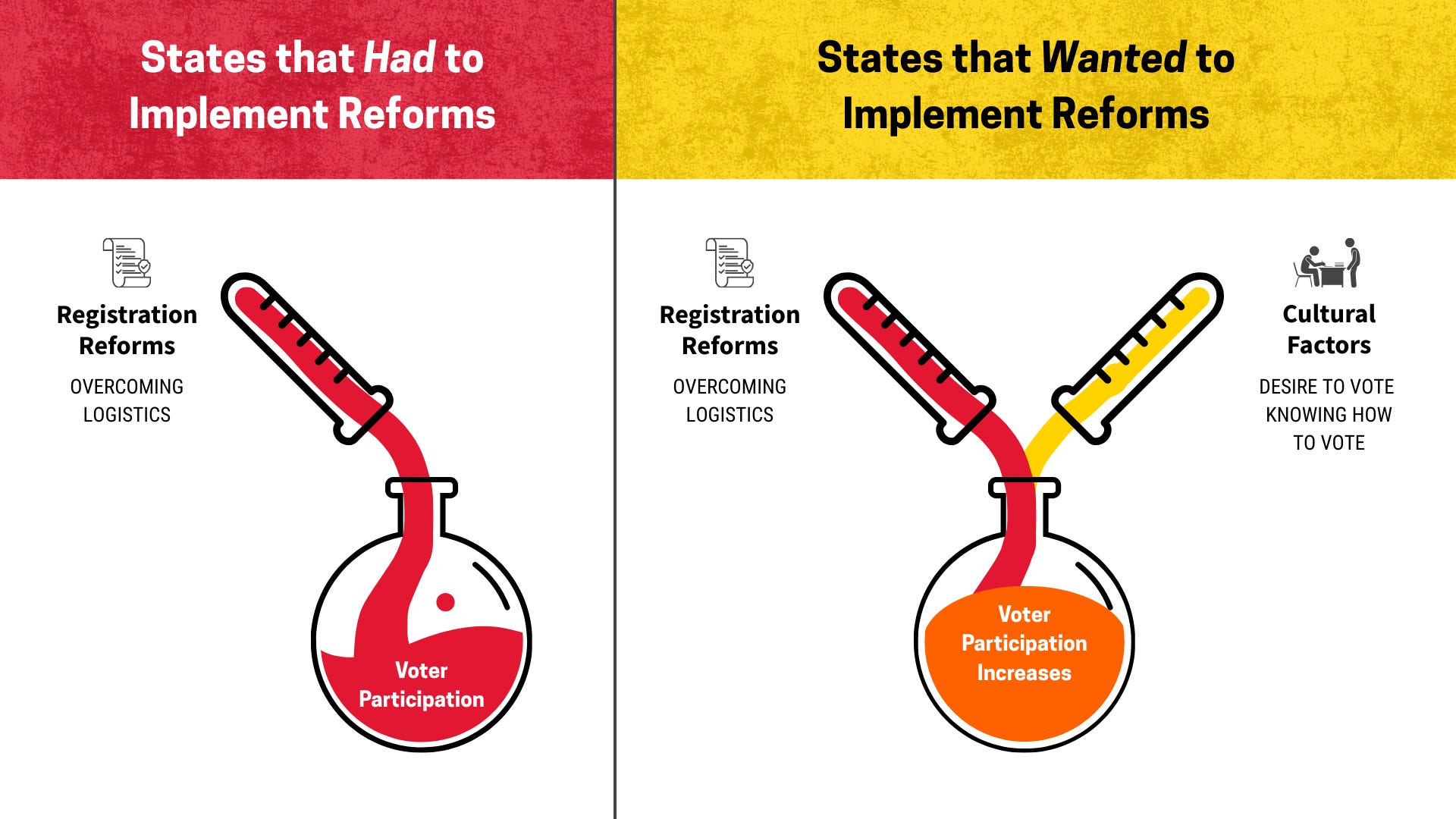
In a world where policy reforms could fully “solve” America’s voter participation challenges, we would not see big differences between the states that adopted policies on their own and the states where the policies were imposed by the federal government. But that’s not what Mike observed in the data. In many cases, states that had a culture and history of facilitating participation saw larger effects from registration reforms even though they started from a much higher baseline level of participation.
Voter registration reforms that reduce the cost of registering and improve the accuracy of voting lists are a good thing for our democracy. These reforms have the potential to both increase participation and trust in our system. But these reforms are not implemented in a vacuum. They are implemented in the same social contexts that cause many voters to not participate. Mike’s data shows that when states reform the registration system without changing the social context the impact of reforms is much lower.
As voter registration changes, local action will need to adapt.
Even if the costs to register go down in many states - and that’s a big if with the SAVE Act to require voters to bring a physical document proving citizenship to their election office to register pending before Congress and lackluster implementation of automatic voter registration in many states - local efforts like the work that happens on National Voter Registration Day will still be needed.

The United States places uniquely high educational demands on its voters. Efforts like voter registration drives that help new voters get ready to vote will be necessary going forward. They may look different if certain elements of the logistics of getting registered are taken care of via improved intragovernmental data sharing (i.e. automatic voter registration!) and other voter registration reforms. But the need to build a local culture of voting and orient new voters to the voting process remain. Local leaders taking action on National Voter Registration Day and throughout the year will continue to play a crucial role in building a democracy where everyone can fully participate.
Sam Novey is the Chief Strategist at the University of Maryland Center for Democracy and Civic Engagement.